

What is Urticaria?
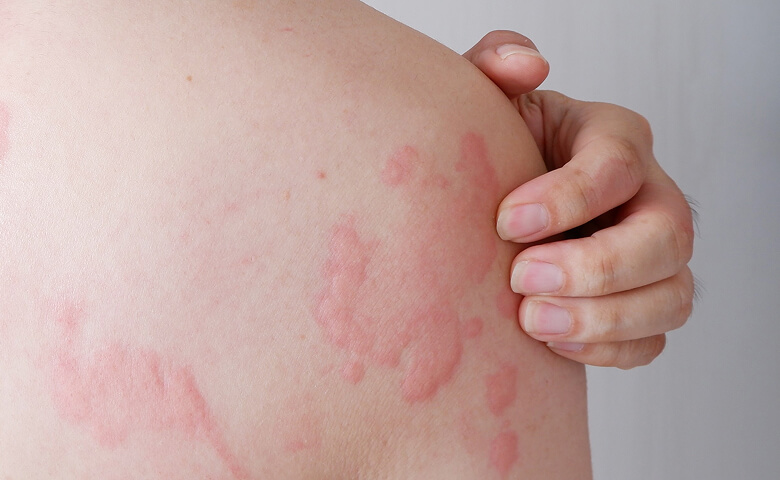
Urticaria, also known as hives, results in itchy, raised, red or skin-coloured welts (wheals). These welts can appear anywhere on the body and usually resolve within 24 hours, but new ones may continue to appear.
The itchy welts occur when mast cells in the skin release histamine, triggering both itchiness and swelling.
When swelling affects the face, including the lips, this is called angio-oedema. Most cases aren’t dangerous, but if the swelling affects the tongue or throat, it can be serious or even life-threatening.
Who gets urticaria?
Urticaria can affect people of all ages and is quite common. It can be very distressing due to the physical discomfort, unpredictability, interference with daily activities and sleep.

What causes urticaria?
There are 3 types of urticaria.
Acute urticaria
This type may result from an allergic reaction to a specific trigger, or from an infection. It usually clears within a few days.
Triggers include certain foods (such as seafood, egg or dairy) and medications (such as antibiotics or aspirin). Infections are often due to harmless cold viruses, though occasionally conditions like hepatitis, glandular fever or mycoplasma may be involved.
Acute urticaria caused by a food or medication usually settles once the trigger is avoided. However the itchy rash will typically recur if the same substance is taken again.
Anaphylaxis is a serious allergic reaction, say to peanuts or a bee sting, that mainly causes difficulty breathing, swelling of the lips or tongue and a drop in blood pressure. While it can include a rash, ordinary urticaria does not turn into anaphylaxis.
Chronic spontaneous urticaria
This is the name of urticaria that lasts for more than 6 weeks.
It is not caused by an allergy, so allergy testing is not helpful. It is thought that a trigger, such as a harmless virus, activates the immune system. Even after the virus has gone, a small part of the immune system continues to misfire, reacting against itself (a so-called “autoimmune” process). This ongoing reaction involves mast cells, which release histamine in an uncontrolled manner.
Occasionally this condition may be associated with chronic infections, including Helicobacter pylori, a type of bacterium that lives in the stomach. Treatment of the infection can settle the rash in some cases.
In most cases however no specific trigger can be identified and treated. Certain factors, such as heat or particular foods, may worsen the rash or itchy, but these are not the root cause.
There is no cure. Instead, treatments (see below) are used to control the itchy rash while the immune system gradually settles on its own. Fortunately this usually occurs within a few months, but in a minority of cases chronic spontaneous urticaria can last for many years.
Chronic inducible urticaria
In this case, itchy welts appear a few minutes after a “stimulus”. The reaction can last for a few minutes or up to an hour.
The stimulus could be:
- scratching the skin (so-called “dermographism”), causing welts in a line
- pressure or vibration, causing itchy or painful swelling at the site
- excessively cold or hot temperature, exercise, emotional stress or spicy food, often causing smaller itchy bumps or itchiness alone (so-called “cholinergic” urticaria)
- contact with a chemical (such as certain foods or latex)
- direct sunlight (uncommon)
- water contact (rare)
How is urticaria diagnosed?
The diagnosis is made by a doctor’s assessment of the history and appearance of the rash. Blood tests are not usually necessary, unless a particular underlying cause is suspected, and a skin biopsy is only needed if a different diagnosis is being considered.
How is urticaria treated?
Excessive heat
Excessive heat, such as a hot shower, should be avoided.
Acute urticaria
Antihistamines can be used to relieve symptoms while waiting for the rash to settle on its own.
Chronic spontaneous urticaria
- Antihistamines are the main treatment. These suppress the rash and itchiness, while waiting for the condition to settle on its own. This may however take months or years. Antihistamines are generally safe, however it is best to avoid ones that cause drowsiness. Sometimes doctors recommend taking non-sedating antihistamines at doses that are higher than what is printed on the packaging.
- Prescription medications such as Doxepin, Amitriptyline or Montelukast can be added to standard antihistamines.
- UVB therapy can be helpful in some cases.
- Omalizumab is an injectable therapy that can only be prescribed by Dermatologists or Allergist. It may be required in severe cases.
Chronic inducible urticaria
- The specific stimulus should be avoided if possible.
- Otherwise the same treatments that are used for chronic spontaneous urticaria can be considered.
What is the outcome of urticaria?
Acute urticaria usually resolves within days. Chronic urticaria of both times can persist for months or years, however in most cases, the rash eventually resolves.