

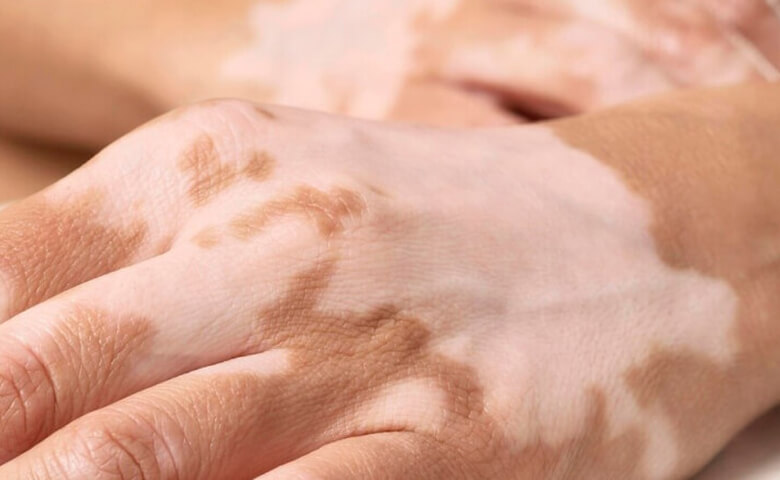
What is Vitiligo?
Vitiligo is a long-term condition in which patches of skin lose their pigment. This occurs when melanocytes, the cells responsible for skin colour, are destroyed.
Who gets vitiligo?
Vitiligo can affect anyone but is more noticeable in people with darker skin. It often begins before age 30.
What causes vitiligo?
The exact cause is unknown, but vitiligo is thought to be an autoimmune condition where a small part of the immune system attacks and destroys melanocytes. Genetic factors play a role, although many people with vitiligo do not have a family history. Other autoimmune conditions, such as thyroid diseases, may present in the family. Stress is a common trigger.
What are the clinical features of vitiligo?
- White patches of skin without scaling.
- Can appear on any part of the body, including the face, hands, torso and genitals.
- Hair in affected areas may also turn white
- Usually not itchy or painful
How fast does it progress?
Vitiligo progresses differently for each person:
- In most cases, small patches appear and gradually increase in size or number. The condition often goes through phases, with periods of activity followed by periods of stability.
- In some people, pigment loss can be rapid and widespread from the outset.
- Complete loss of skin colour across the whole body is uncommon.
Prognosis
Vitiligo is treatable, especially if therapy begins early. The outcome depends on:
- Location of involvement: Areas with many hair follicles (such as the face) have a better chance of repigmentation. Areas without hair follicles (knuckles, lips, around the fingernails, some parts of the genitals) have a poorer prognosis.
- Hair colour: If hair in the area has turned white, the chances of repigmentation are low, as no pigment cells remain to restore the skin’s colour.
Sunlight
White patches of skin are more sensitive to sunburn than unaffected areas. When used carefully however, natural sunlight or UVB therapy (see below) can help stimulate dormant pigment cells in the hair follicles. This should always be done under the supervision of a dermatologist.
If certain areas are no longer responsive to treatment, it is usually best to avoid sunlight, as tanning of the surrounding skin can make vitiligo patches appear more noticeable.
Importantly, melanoma (a cancer of pigment cells) cannot develop within vitiligo patches, since the pigment cells have disappeared. In fact, studies show that people with vitiligo have a lower risk of melanoma in normal skin due to their overactive immune system.
Treatment
Vitiligo should be treated as early as possible. Too often, treatment is delayed or is not intensive enough, which reduces the chance of success. Starting early not only increases the likelihood of repigmentation but also helps stop the disease from progressing and lowers the risk of permanent disfigurement.
General Measures
- Be gentle with the skin: Vitiligo can sometimes develop in areas where the skin has been injured or subjected to repeated friction. Avoid tight clothing such as belts or shoes that rub against the skin. When washing, cleanse gently rather than scrubbing vigorously. Overall, treat the skin with care to minimise irritation and trauma.
- Cosmetic camouflage: Options such as specialised makeup or products like ZandermTM (a pen-like self-tanner) can improve the appearance.
- Psychological support: Vitiligo can significantly impact self-esteem. Support groups, such as the Vitiligo Association of Australia, may be helpful.
Medical Treatments
- Topical therapies: Cortisone (steroid) creams or non-steroid creams (eg, tacrolimus, ruxolitinib) can prevent patches from enlarging by reducing the immune attack. These should be started as soon as new patches appear.
- Phototherapy. The key treatment in vitiligo. Narrowband UVB light both reduces the immune attack and stimulates pigment cells. Treatments are usually given 2-3 times per week in dermatology clinics, although small home-use devices can also be used. The so-called excimer lamp, which delivers UVB at a higher dose to a small area, is only available in select centres.
- Oral medications: In rapidly spreading cases, dermatologists may prescribe immune-suppressing medicines.
Surgical treatment
This is reserved for stable vitiligo (patches that are not spreading and have not responded to medical therapy). These procedures are performed only by specialists with expertise in this area, and include cellular grafting, punch grafts or blister grafts.
Skin bleaching (depigmentation therapy)
In this treatment, a prescription-strength bleaching cream is applied to remove the remaining normal skin colour. This approach is permanent and considered only for extensive cases of vitiligo that have not responded to other treatments.
Outcome
The course of vitiligo is unpredictable. The immune system may stop attacking the pigment cells for a period, only to restart later – often triggered by stress. While vitiligo is not physically harmful, it can deeply affect confidence, self-image and mental wellbeing.